Hypervisor Enforcement Boundaries That Container Namespaces Cannot Replicate at Agent Runtime Depth
Firecracker microVMs give each agent its own kernel, and 2026's kernel escapes show why.
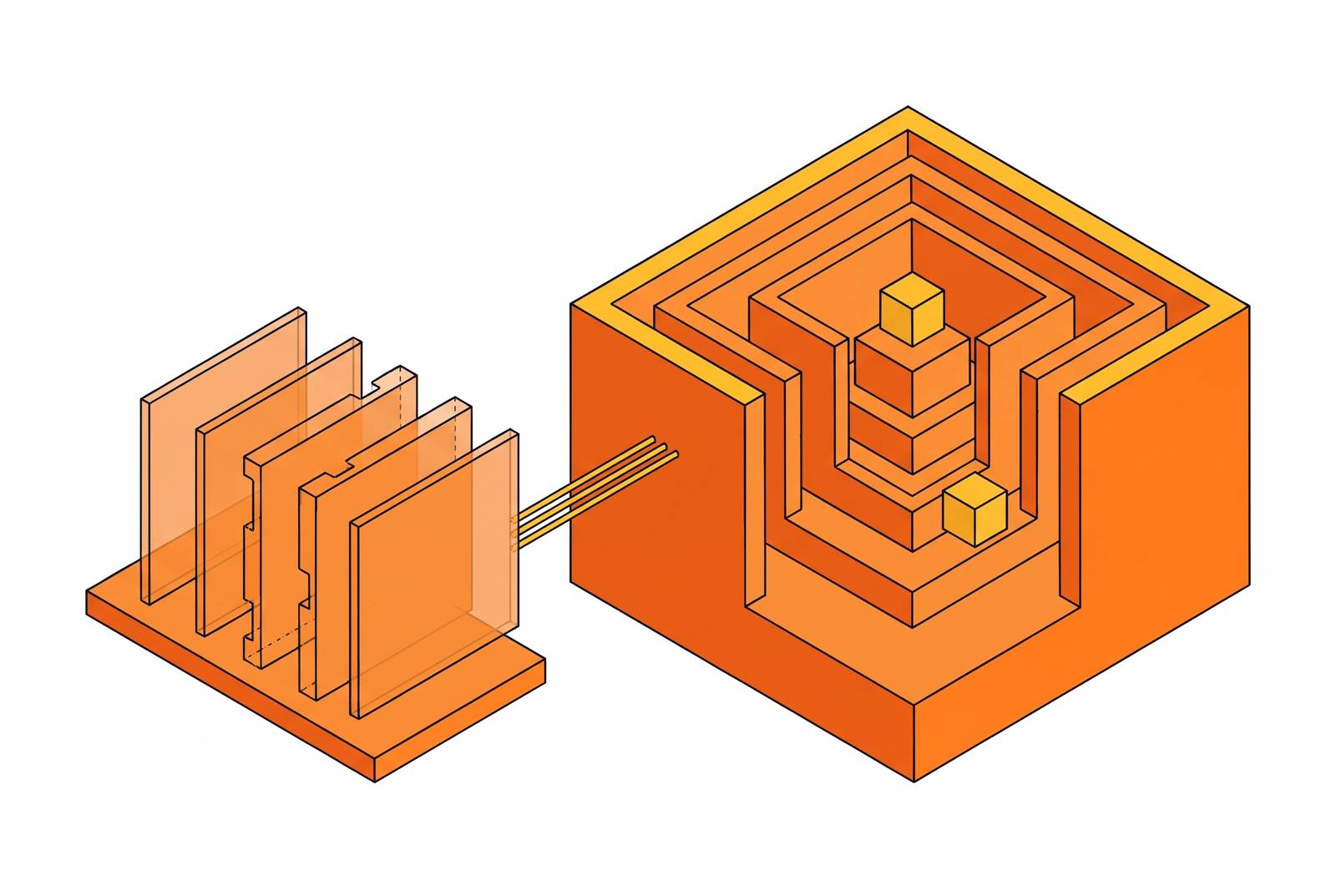
Firecracker micro-VM isolation gives each AI agent its own guest kernel behind a hypervisor boundary, so a shared host kernel does not have to contain the untrusted code. For agents running model-generated or user-supplied code, that is the stronger boundary because compromising the guest kernel does not by itself compromise the host.
Why the container boundary is a software fiction over a shared kernel
A container is a process with a modified view of the system. Linux namespaces control that view through clone(), unshare(), and setns(). The eight namespace types cover mount, PID, user, network, IPC, UTS, cgroup, and time, while cgroups impose resource limits. None sits below the kernel enforcing it. The same kernel runs the process and decides which resources it can see and use.
That distinction is a design choice. Containers keep processes apart but share the host kernel, while virtual machines virtualize hardware and each run their own guest operating systems. Separate apartments in one building versus separate houses is a useful analogy, provided the shared infrastructure is understood to be the kernel. A container can have its own filesystem view, process identifiers, and network view without owning the machinery that enforces any of them.
What a hypervisor boundary actually interposes between a process and the hardware
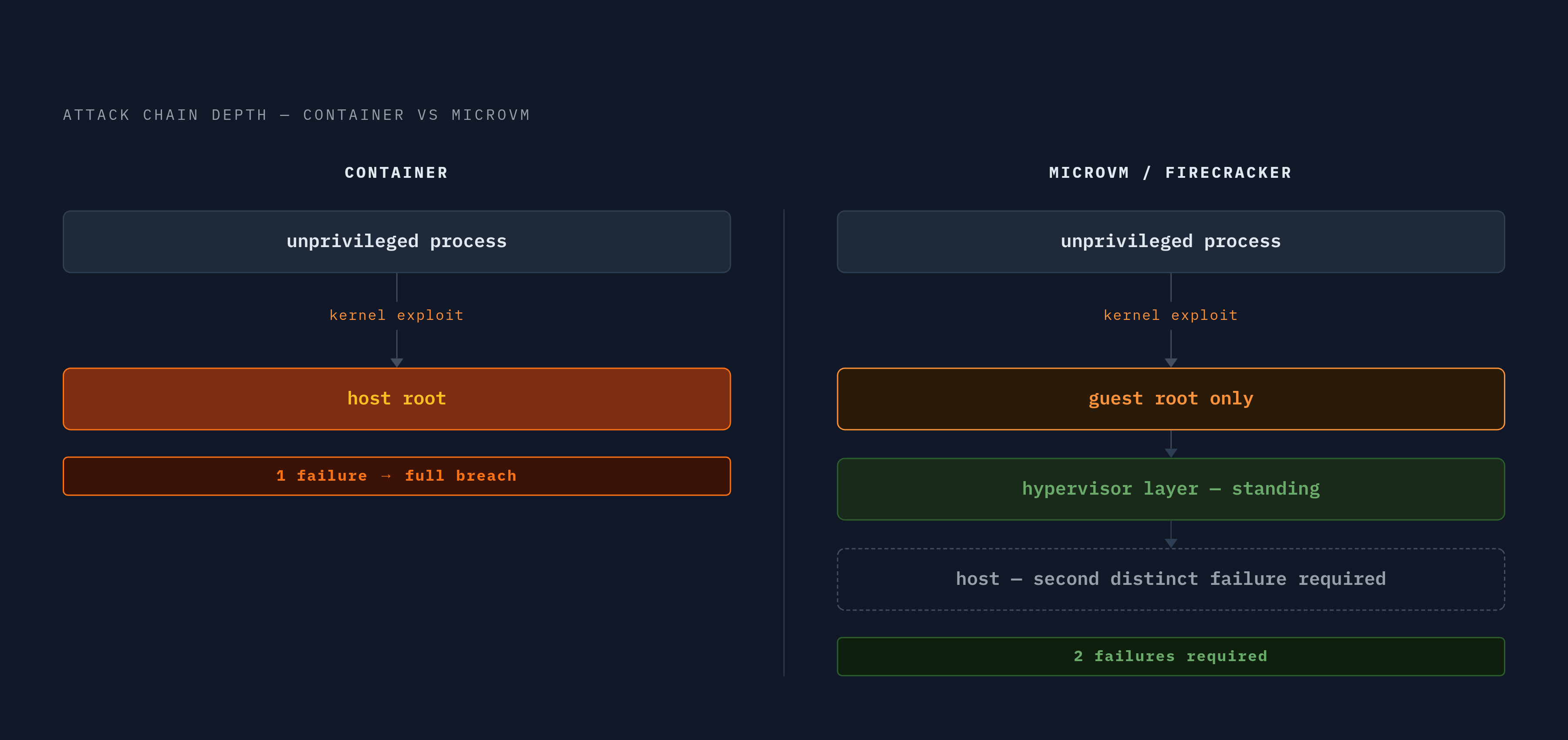
Physical hardware supports a hypervisor, which presents virtual hardware to a guest kernel and its user-space processes. A Type 1 hypervisor runs on the hardware itself, while a Type 2 hypervisor runs on a host operating system. The guest owns its operating-system view. Hardware virtualization supports the separation.
That changes what a kernel compromise buys an attacker. In a container, a shared-kernel flaw may be enough to reach the host, with no hypervisor boundary left to cross. In a VM, taking over the guest kernel still leaves the attacker inside the guest. Reaching the host through that route requires a separate failure in the virtualization layer. The added layer makes a kernel flaw just one step in an escape, so an attacker has more work to do to complete an exploit chain.
How the 2026 Linux kernel CVE landscape changed the economics of container escape
The 2026 vulnerabilities made that difference concrete. CERT-EU describes Copy Fail, CVE-2026-31431, as allowing an unprivileged local user to gain root and break out of container isolation. DepthFirst describes CVE-2026-80521 as reaching host root from an unprivileged container process. Dirty Frag and Fragnesia supplied further cases of the container boundary being crossed from an unprivileged local account. These were failures at the layer containers depend on.
The economic change was in finding those flaws. With AI-assisted vulnerability discovery, engineering work that could take years took hours, which made the shared kernel cheaper to probe. One 2026 patch addressed a long-standing exploitable bug, illustrating why a mature kernel is not a finished security boundary. Patching remains necessary to manage a continually changing surface.
Hypervisor vulnerabilities are still rare by comparison, with each researcher finding only a handful per year. Rarity is not immunity. The structural advantage is that a guest-kernel flaw does not automatically become a host-kernel flaw, so faster kernel-bug discovery does not erase the extra boundary.
Why AI agents are precisely the workload that maximally exposes the container gap
Attacker-influenceable input is part of an agent’s normal working environment. An agent may write and run code after it reads a document, gets a tool result, or follows a user request. A prompt-injected document or malicious tool result can steer that code toward network probing, data theft, or privilege escalation. The agent wrote the code, but that does not make it trusted. Treating its output like a signed application from a known developer mistakes the origin of the executable for the origin of its instructions.
A session can hold context, credentials, signed-in services, and open file handles over minutes to hours, all of which are exposed within a compromised session. Its pauses do not mean the task is finished. Waiting for a model response, tool call, or human approval can require preserving that state. A long-lived session in a shared-kernel container is therefore a long-lived opportunity for a kernel exploit to land.
How do you give each AI agent its own isolated kernel?
A microVM gives each agent session an independent guest kernel behind a hypervisor. A kernel vulnerability exploited inside that guest threatens the guest first. The boundary remains separate from the vulnerable operating system. Firecracker makes this practical for per-user and per-task instantiation without treating every agent launch as a heavyweight, minutes-long VM boot.
Container hardening serves a different purpose. Seccomp profiles, AppArmor/SELinux, and minimal capabilities restrict what a process may ask the shared system to do. gVisor also reduces exposure, but it does not give each session an independent guest kernel behind a hypervisor. These defenses narrow attack paths without reproducing the VM boundary. Kata Containers follows the VM approach by giving each container its own lightweight VM kernel, showing that container packaging and hypervisor isolation are compatible choices.
MicroVMs also support a clean lifecycle for untrusted work. A warm snapshot can provide a pre-initialized starting point, with copy-on-write forks diverging independently. At task end, deleting the disposable microVM and its disk removes the state that a later task might otherwise inherit. Snapshot and resume can preserve a session.
How persistent agent state and checkpoint-resume make the microVM the right shape for long-running agents
An idle agent may still have a signed-in browser, open files, and unfinished document edits. Keeping a container running preserves those things but also keeps its CPU and memory allocation occupied through the wait. Restarting it loses the in-memory state. Checkpoint-resume can save the running machine’s state while it stops running.
A Firecracker snapshot restore is not a reboot. The virtual machine monitor memory-maps the snapshot file, loads CPU state, and resumes execution without starting the guest kernel or agent again. The session resumes where execution stopped. This matches work that alternates between short bursts of activity and waits for outside responses. The security boundary and the unit of saved state are the same guest machine.
Cloud designs corroborate that architectural fit. AWS Lambda MicroVMs, generally available June 22, 2026, offers per-session Firecracker VMs launched from snapshots for extended stateful sessions. Google described Agent Compute Engine on October 22, 2026, with a microVM per agent session, checkpointing while the model thinks, and copy-on-write cloning from warm snapshots. Kimi AgentENV applies the same pattern in open source through Firecracker sandboxes with pause/resume and live forks into independent children.
Why per-user and per-task microVM instantiation changes the cost model for agent fleets
The relevant cost variable is active concurrency. With per-second billing and no charges for sleeping machines, an agent fleet pays when sessions wake and run, so it can stop each customer’s environment while it waits. That pricing condition is essential to the comparison. When most agents are waiting, however, sleep-and-resume can reverse the apparent cost advantage of always-on containers.
The same logic applies to reinforcement learning rollouts and evaluation pipelines. Each rollout can get a fresh microVM, discard its disk at completion, and leave no active fleet between batches. Correctness is an equally important benefit here. Reused container workers can accumulate packages, files, and caches from earlier runs, making later passes and failures harder to attribute to the agent being tested. Disposable environments remove that source of contamination, eliminating the need for manual audits at rollout scale.
Copy-on-write live forks also reduce repeated setup work. Each trajectory can branch from the same initialized machine and then diverge independently. This is useful when initialization is expensive but each branch needs a separate environment. The saved setup is not permission to reuse a previous trajectory’s leftovers. A shared starting snapshot and a reused working directory serve different purposes.
Where the hypervisor boundary does not eliminate risk — and what the residual attack surface looks like
A mounted host filesystem can bypass the separation a hypervisor provides. So can a forwarded socket or ambient credentials baked into a base image, because these offer access without requiring a hypervisor escape. A guest with a route to privileged host operations is not protected from using that route merely because its kernel is separate. Isolation has to include what the VM is allowed to reach.
The hypervisor itself is also code with bugs. A successful escape could compromise the host and other VMs, so the claim is a narrower attack surface. Guest isolation also cannot protect data from code that is already allowed to read and send it. The architecture must limit both escape paths and the damage possible through permitted actions.
For the people building these systems, that means keeping ambient credentials out of base images and brokering short-lived, scoped tokens for each call. Default-deny egress should restrict sandboxed code to an allowlist, while a scoped, rotatable workload identity limits each agent’s authority. Trusted workloads can still justify hardened containers when VM overhead is not warranted. Neither choice removes the need to maintain the system around it. Realized exposure turns on six controls, namely mounts, forwarded sockets, capabilities, egress policy, kernel patching cadence, and session lifetime.
How to map agent workloads to isolation boundaries by threat profile
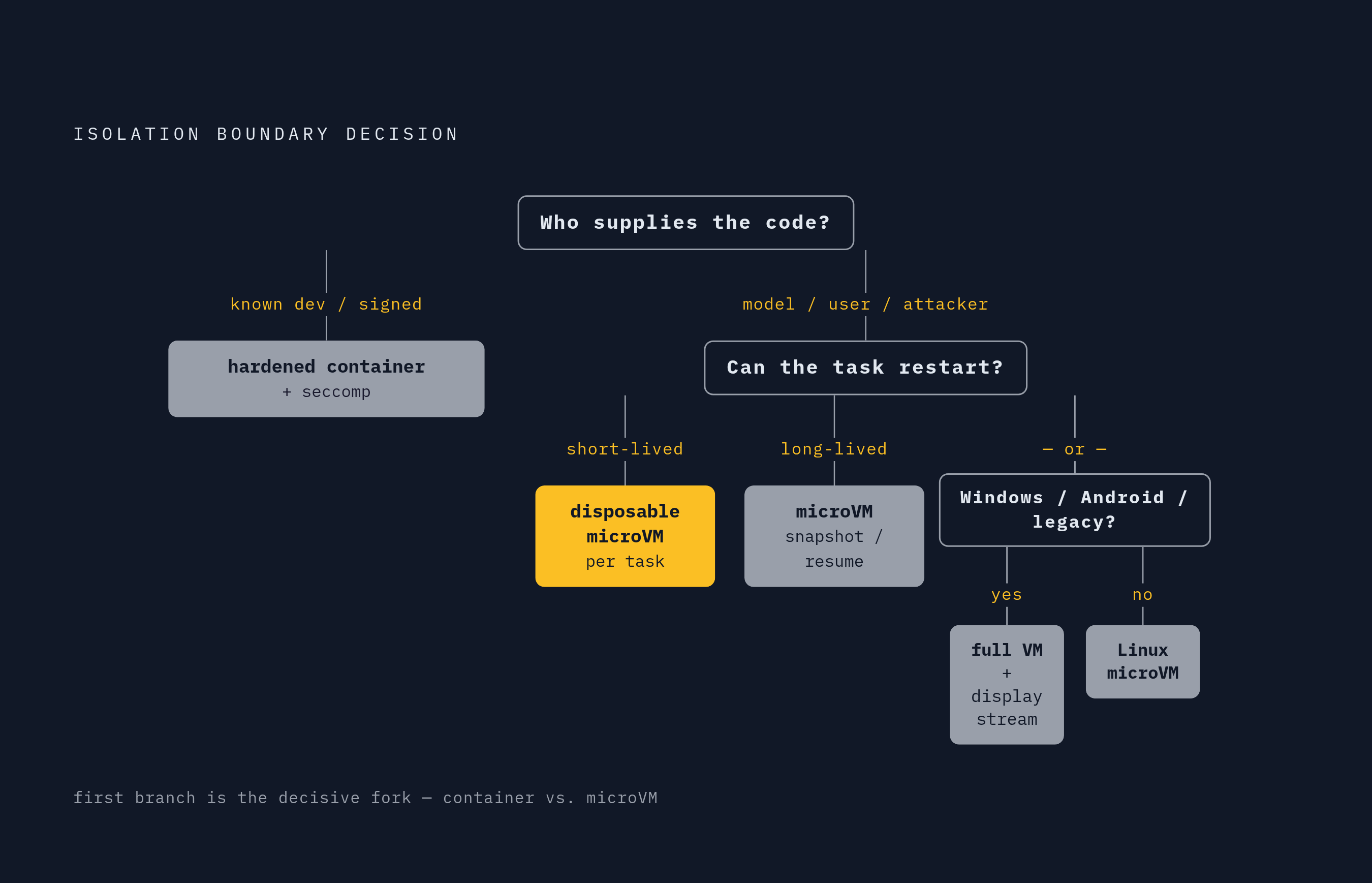
The practical decision starts with who supplies the code. If it comes from a known developer in a signed image, with no runtime code generation, hardened containers with seccomp and minimal capabilities are a reasonable choice. The shared-kernel risk remains, but the workload is controlled. If code is model-generated, user-supplied, or attacker-influenceable, put it behind a microVM boundary instead.
Next, ask whether the task can tolerate restarting. A long-lived session with signed-in services, open browsers, or unfinished edits calls for snapshot/resume. A short-lived evaluation or reinforcement learning rollout instead calls for a disposable microVM per task, so earlier work cannot contaminate the result. These are different lifecycle requirements. Both benefit from separating each task’s working state from that of other tasks.
The target environment can narrow the choice further. Computer-use agents working with legacy Windows applications, Citrix environments, or phone-only apps need a full environment with the target application installed and signed in. A Linux container is not a substitute for that environment. The appropriate boundary may be a microVM, Windows VM, or Android instance. If a human must take over mid-session, the guest display also needs a live stream so that the handoff preserves the same working session.
Finally, classify the credentials and data the process can reach. For ePHI or other sensitive data, pair isolation with default-deny egress, scoped per-agent identity, no ambient credentials, and a BAA from every vendor in the path that touches the data. A microVM is necessary but not sufficient for that threat profile. The final test is simple. “If this process finds a kernel CVE published next month, what can it reach?”
Sources
- From Hypervisor to Container: Cloud Security Vulnerabilities, Defense Mechanisms, and Open Challenges
- Docker Containers vs. Virtual Machines: A Comparative Study of Architecture, Performance, Configuration, and Security
- From Hypervisor to Container: Cloud Security Vulnerabilities, Defense Mechanisms, and Open Challenges