gVisor vs Firecracker Security Tradeoffs in Multi-Tenant Agent Deployments
Firecracker trades operational complexity for stronger isolation than gVisor's software approach.
In multi-tenant agent deployments, you run code nobody on the platform team actually wrote. An LLM generates it, an external user supplies it, or a tool response an attacker crafted drives it, and the standard container security model was never built for that situation.
A Linux container shares one kernel with everything else running on the host. Every syscall a containerized process makes goes straight to that shared kernel, and namespaces and cgroups only narrow what a process can see and touch. They do nothing to change which kernel actually handles its requests. The Linux kernel exposes roughly 350 system calls, and a single exploitable bug in any one of them can turn into a container escape. For first-party code that a team wrote, tested, and trusts, that shared-kernel design is a reasonable engineering tradeoff. For code an agent assembled on the fly in response to a tool call, someone has to make that tradeoff a decision on purpose. MCP-style agent deployments bring a specific set of threats that assume exactly this: prompt injection carried in a malicious tool response, credential exposure through a compromised MCP server, command injection that lets arbitrary system commands run, and SSRF attacks launched from inside the sandbox. Each one depends on the platform not fully controlling the code the agent executes. Platforms like Maritime respond to this by giving each agent its own isolated Firecracker micro-VM, so the security boundary moves away from the shared host kernel entirely, and the architecture handles the threat model instead of a team having to hope its container config catches it.
The architectural difference that drives every tradeoff
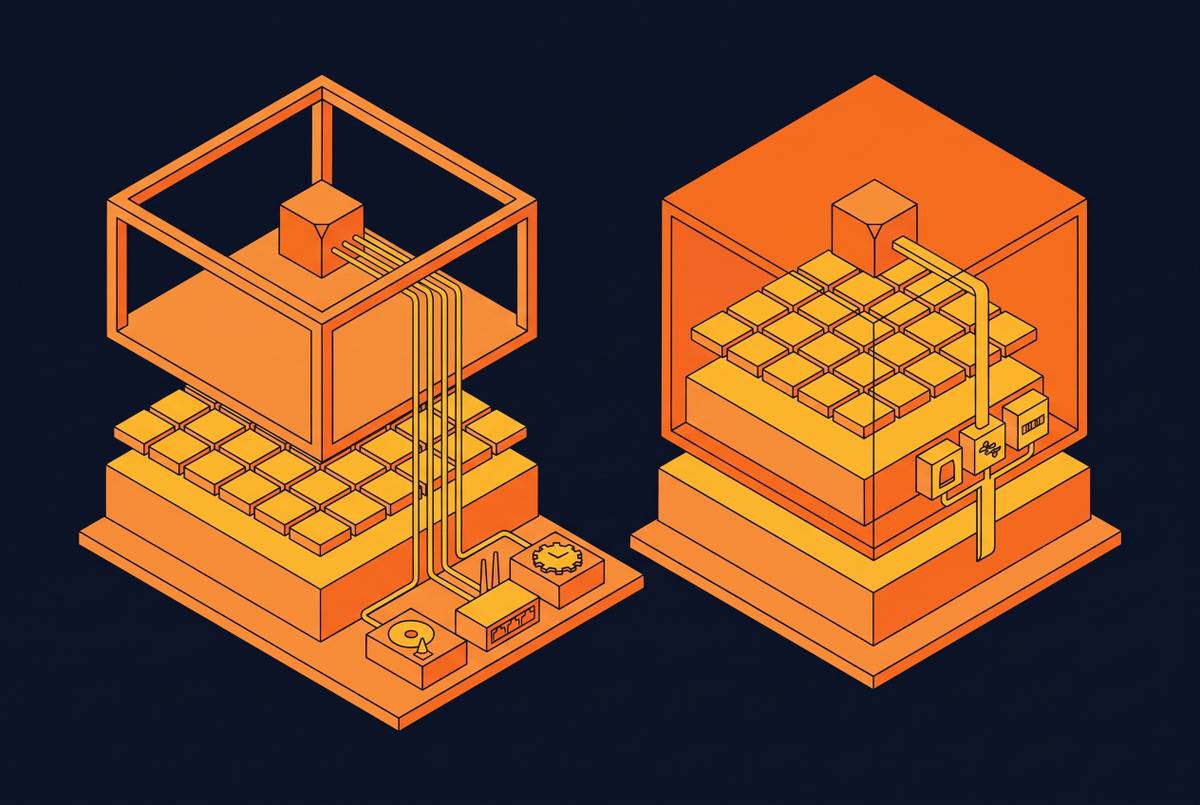
gVisor and Firecracker both start from the same premise: the shared host kernel cannot be the security boundary for untrusted agent code. Where they disagree is where to put that boundary instead. gVisor places it in software, at the point where a userspace component intercepts syscalls before they reach the kernel. Firecracker places it in hardware, at the point where KVM virtualization separates a guest kernel from the host CPU. Everything else that distinguishes the two technologies, their memory cost, their performance tax, their compatibility gaps, their resistance to a determined attacker, follows from this one architectural fork.
Firecracker boots a dedicated guest kernel inside every microVM, sitting on top of KVM hardware virtualization. An agent's code talks to that guest kernel the same way it would talk to any Linux kernel, except the guest kernel is separated from the host by the CPU's own virtualization features. To reach the host, an attacker has to first break the guest kernel, then break out of the VM itself. Firecracker is a VMM written in Rust by AWS, and it strips device emulation down to a short list: virtio-net, virtio-block, virtio-vsock, a serial console, and a minimal keyboard controller. No BIOS, no PCI, no USB. The attack surface is the hypervisor itself, and that hypervisor is a small, auditable codebase.
gVisor works differently. A userspace component called the Sentry, written in Go, intercepts every syscall a sandboxed process makes and services most of them itself, without ever handing them to the host kernel. Only a small, tightly filtered set of operations makes it through to the host, and that set has to pass behind a seccomp filter. The effect is that the host kernel's exposed attack surface shrinks from the full roughly 350-call syscall table down to the handful of calls the Sentry itself needs to make on the sandboxed process's behalf.
| | Firecracker | gVisor | |---|---|---| | Isolation mechanism | Hardware virtualization (KVM) | Software syscall interception (Sentry) | | Guest kernel | Dedicated, per-microVM | None, host kernel services filtered calls | | Needs KVM | Yes | No | | Host attack surface | VMM only (minimal device set) | Small filtered syscall subset | | Escape path | Break guest kernel, then break out of VM | Escape the Sentry process |
That last row is the whole comparison in miniature. A gVisor escape is a process-level escape from the Sentry. A Firecracker escape requires defeating hardware-enforced VM isolation on top of a guest kernel. The second bar sits materially higher than the first.
Firecracker's hardware boundary: memory, boot time, and operational complexity costs
Hardware isolation carries a bill that comes due in three places: memory, boot time, and the operational muscle needed to run it. Each microVM needs its own kernel image and its own memory space, so the per-VM overhead is small on its own but adds up fast once a platform is running thousands of agents at once. At that kind of concurrency, the gap between Firecracker and a plain container turns into a real line item, not a rounding error.
The bigger cost is operational. Firecracker is a VMM, not a container runtime, and running it directly means owning kernel image management, network orchestration, jailer configuration, and the full lifecycle tooling a VM needs from boot to teardown. Edera's isolation guide states that for most platform teams, running Firecracker directly means effectively becoming a virtualization company. That is a different kind of organization than most teams set out to build.
The standard answer to memory cost at idle is snapshot-restore. Instead of keeping a microVM running between agent sessions, the platform freezes it to a disk image and restores it on demand. Idle cost drops to the cost of storage, and because every restore starts from the same clean, baked baseline, no state can leak from one tenant's session into another's. Copy-on-write memory means many restores of a single template can share host RAM, which improves density further. This is the architectural insight behind Maritime's scheduling model, where agents sleep on disk and wake in under a second, so what a developer pays for between sessions is storage.
Firecracker's hardware boundary also closes off a path some agent workloads now need. Google's GKE Sandbox documentation confirms that Firecracker microVMs in the microVM-per-pod configuration do not support GPUs or TPUs. For agent workloads that need local inference or CUDA execution, that's a hard constraint, not a configuration detail to work around.
What the operational complexity looks like when a team pushes through it is worth seeing in full. Atlassian built Fireworks, a Firecracker microVM orchestration platform on Kubernetes, using its own Rovo Dev AI agent system. The result delivers 100ms warm starts, live migration between hosts, eBPF network policy enforcement, shared volumes, and snapshot filesystem restore. Getting there meant building a scheduler, an autoscaler, node agents, envoy ingress layers, and raft persistence, among other components. Firecracker's hardware boundary is a real cost to take on, but Fireworks shows that cost is bounded and buys a level of isolation and performance a team can design around.
gVisor's software boundary: syscall overhead, compatibility, and enforcement gaps
gVisor cuts the host kernel's exposed attack surface down sharply, but it does not remove the host kernel from the picture, and reimplementing the Linux syscall surface in userspace brings its own costs. The first is performance, which rises in proportion to syscall volume. CPU-bound work that rarely touches the kernel runs close to native speed inside gVisor. Workloads that make many small network calls, do heavy file I/O, or fork and exec frequently pay a real, measurable cost, because every one of those syscalls has to pass through the Sentry before it goes anywhere. I/O-heavy agent workloads feel this tax the most directly.
The second cost is compatibility. Because the Sentry reimplements Linux rather than wrapping it, some less common syscalls and /proc features either aren't supported or behave differently than they would on a native kernel. Resource limits inside the sandbox are a particular gap: gVisor's in-sandbox cgroups handle accounting, but they don't enforce limits on their own. Enforcing a resource ceiling means wrapping gVisor in a Linux-native host cgroup, and even then, that only sets a limit at the level of the whole sandbox. It cannot arbitrate resource limits between competing processes running inside the same sandbox. gVisor also doesn't support direct hardware access, kernel modules, eBPF programs loaded from inside the sandbox, HostPath volumes, privileged containers, or KVM used from within the sandbox.
What matters more is the kind of threat this software boundary can actually hold against. gVisor is a strong answer to code that misbehaves by accident, where a buggy or reckless agent mostly just hurts itself. It's a weaker answer to a tenant that is deliberately hunting for a kernel escape, because the host kernel still sits one boundary away behind the Sentry. A gVisor escape is a process-level escape, not a VM escape, and that distinction is the whole argument. Google runs gVisor at scale across Cloud Run and GKE Sandbox, so you know the technology holds up under heavy production load. But those environments are built around reckless or buggy code as the threat model, not a multi-tenant platform that knowingly hosts adversarial agent workloads, and that is a different bar to clear.
Where gVisor pulls ahead is GPU access. It supports GPU access through a managed proxy path on platforms that enable it, while Firecracker's microVM-per-pod approach on GKE rules GPUs and TPUs out. As more agent workloads start needing local inference or CUDA execution, that access path matters, and it's one gVisor keeps open where Firecracker's hardware boundary shuts it.
Matching the isolation mechanism to the threat model
Neither technology is better than the other in the abstract. The question that actually decides the choice is what the deployment's security boundary has to hold against: careless code that might misbehave, or a deliberate adversary actively probing for a way out.
Firecracker is the right call when the platform runs genuinely untrusted, multi-tenant code, agent tools, user-supplied scripts, or MCP server execution, where the threat model includes someone deliberately hunting for a kernel escape. It's also the right call when compliance or audit requirements demand a VM-level boundary, since a hardware boundary is easier to document and reason about than a software interception layer. It fits naturally with a persistent-agent session model, the "one session = one microVM" pattern Amazon Bedrock AgentCore Runtime uses, which lines up isolation granularity with the per-user agent as the basic unit of the system. And it fits workloads where snapshot-restore economics make the memory overhead a manageable cost.
gVisor is the right call when a platform already runs on Kubernetes and needs a runtime swap with minimal new orchestration, since gVisor drops in as a RuntimeClass. It fits CPU-bound, syscall-light workloads well, coding agents that edit, test, and lint, or API-calling agents with modest file I/O, where the per-syscall tax stays small. It's the only option where hardware virtualization isn't available at all, in nested-VM environments, some CI runners, and cloud VMs that don't expose KVM. And it's the right call when GPU access is required and the platform has no VFIO passthrough path, since gVisor keeps that access open where Firecracker's hardware boundary forecloses it.
Few platforms will find either technology sufficient on its own, and the practitioner consensus, echoed in Edera's isolation guide, lands on a layered approach instead: MCP protocol-level tool scopes as the first layer, gVisor or Firecracker isolation as the second, network policies as the third, and seccomp or AppArmor as the fourth.
Even a well-chosen, well-layered boundary leaves a gap that neither technology touches, since gVisor and Firecracker both just control where an agent runs. Every native isolation control assumes that an action taken within its configured permissions is legitimate. AI agents break that assumption by design, since they generate their own code, call tools dynamically, and act on untrusted input in ways that look, from the sandbox's point of view, identical to ordinary operation. Sandboxing is a necessary piece of safe multi-tenant agent hosting. It is not the whole of it.
Operating each isolation model at scale in production
The architectural differences between gVisor and Firecracker aren't just a design-time comparison. At production volume they turn into distinct operational disciplines, and the teams running each one at scale have had to solve genuinely different engineering problems to get there.
AWS Lambda's serverless compute runs on Firecracker's KVM-based virtualization, and Amazon Bedrock AgentCore Runtime uses Firecracker to run AI agent tools in isolated environments, structured one session to one microVM. That structure puts the per-user agent primitive into production at real scale, not as a design pattern on a whiteboard. Atlassian's Fireworks platform shows the same hardware boundary pushed even further: a Firecracker microVM orchestration layer on Kubernetes, built using Atlassian's own Rovo Dev AI agent system with minimal human-written code. Fireworks delivers 100ms warm starts, live migration between hosts, eBPF network policy enforcement, shared volumes, snapshot filesystem restore, and sidecar sandboxes. None of that came for free: reaching it meant building a scheduler, an autoscaler, node agents, envoy ingress layers, and raft persistence from the ground up.
Firecracker's hardware virtualization boundary, where each microVM boots its own guest kernel on top of KVM, is what makes this level of isolation possible: an agent's syscalls never reach the host kernel directly, and an attacker has to break both the guest kernel and the hardware virtualization layer underneath it to get out. That is a materially higher bar than a process-level escape, and it's the reason AWS, Amazon's Bedrock team, and Atlassian all built toward it despite the operational weight involved. Snapshot-restore scheduling is what makes that same boundary affordable at scale: freezing idle VM images to disk instead of keeping them running drops idle cost to near zero while preserving agent state and sub-second wake latency across tens of thousands of concurrent sessions. The production record for Firecracker and gVisor alike says the same thing from different directions: the isolation mechanism a platform chooses has to match the threat it is actually defending against, because the engineering cost of getting that choice right is paid in full either way.